

The trip was always going to happen. We changed what it costs the city.
You still need to get to the airport. Your mum still needs to get to her appointment. That journey is happening either way — the only real question is what comes out of the exhaust while it does.
Around nine in ten cars in the ME CABS fleet are hybrid or electric. Not so we can put a leaf on a website. Because we live here too.
- No green option to tick
- No surcharge
Carbon Savings Calculator
See how much CO₂ you save by choosing ME CABS over a petrol car
In one line
Around 90% of our fleet is hybrid or electric — so the standard ME CABS trip is already the lower-emission one. No green option to tick, no surcharge to pay.
Why a taxi's engine matters more than yours.
A working taxi covers in months what a family car covers in years. Electrifying the vehicles that never stop driving is where the real difference is made.
The average Melbourne car sits parked for something like 95% of its life — the school run, the shops, a weekend trip. A taxi does none of that. It’s out on Hoddle Street at 6am and still out at midnight, the same vehicle, over and over. One commercial vehicle burns fuel at a rate a private car simply never reaches.
Flip that around and it becomes the good news. Change what one taxi runs on, and you’ve changed something far larger than one car. So when someone asks whether one taxi company’s fleet decision really matters in a city of five million: yes. Disproportionately. That’s the whole point.
of a private car’s life is spent parked.
a day a taxi is out on the road while yours is at home.
a commercial driver in an electric vehicle can deliver versus an average car owner — by one major operator’s own public estimate, precisely because of those kilometres.
What's actually in our fleet.
Around nine in ten ME CABS vehicles are hybrid or fully electric. The remainder are specialist vehicles where no suitable low-emission option exists yet.
Hybrids do the bulk of the work — for a vehicle running long airport and regional shifts they remain the most dependable low-emission choice in Australian conditions today. Fully electric vehicles are in the fleet and growing as charging and range improve.
The part nobody else explains
Our wheelchair-accessible vans and some larger group vehicles are built on van platforms where a hybrid or electric equivalent doesn’t exist in Australia yet. We won’t sacrifice a wheelchair-accessible vehicle to improve a percentage. Accessibility comes first — we’ll swap those the moment there’s a genuine option.
Hybrids do most of the work today; fully electric is a growing share. That last 10% is wheelchair-accessible and larger group vehicles, where a suitable low-emission option isn’t available in Australia yet.
What this means for the city we share.
Lower tailpipe emissions mean cleaner air at street level — on the footpaths, in the laneways, outside the schools, along the roads Melbourne actually walks.
Climate targets are abstract. Air is not.
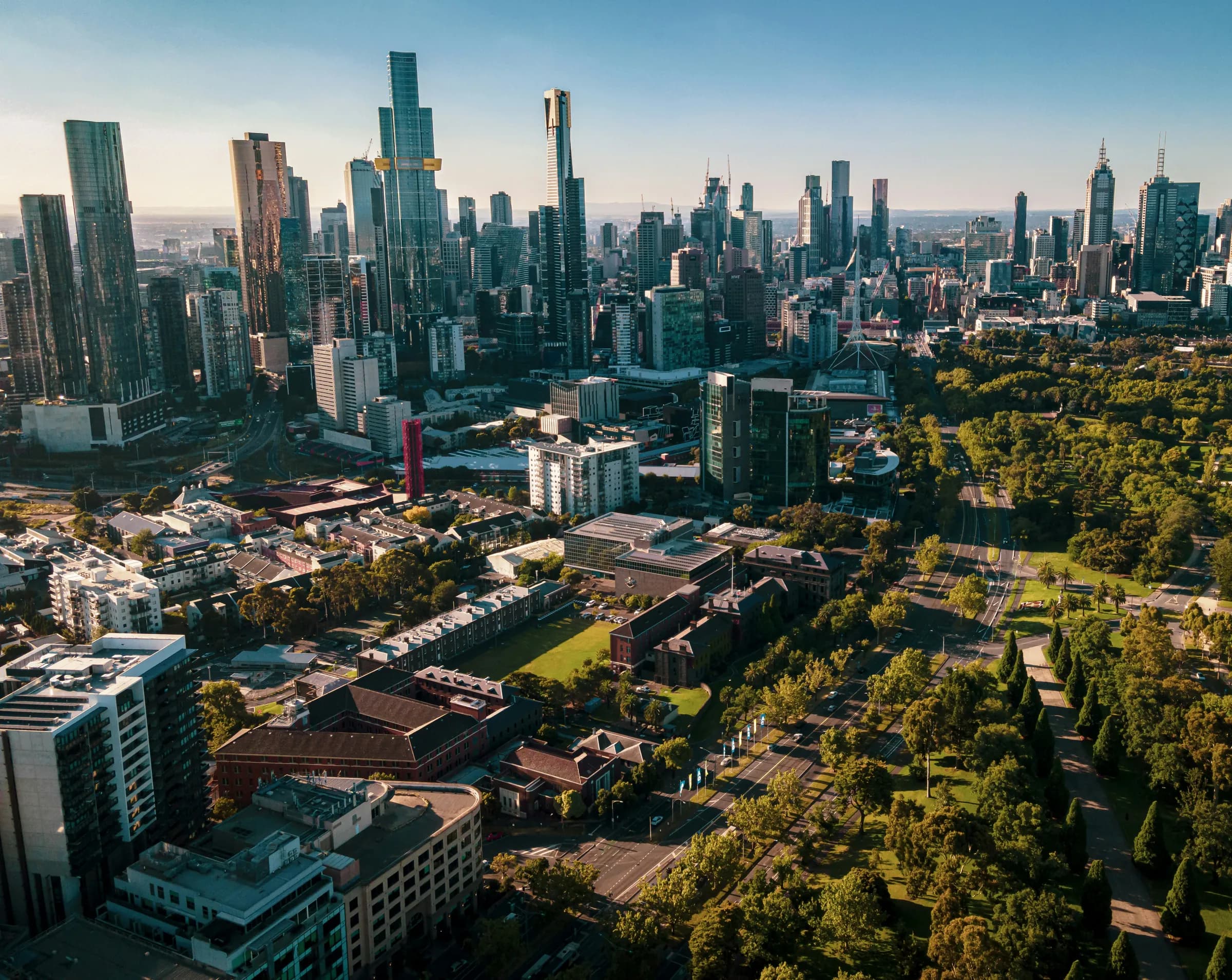
Melbourne is a walking city. People move through the laneways on foot, queue for coffee on the footpath, run the Tan in the morning and walk under the elms on St Kilda Road. Kids wait at tram stops on Sydney Road and Glenferrie Road twice a day, at head height with the traffic beside them.
Exhaust from the cars on that road doesn’t rise politely into the atmosphere to become a statistic — it stays down at street level, where people are breathing. A hybrid on its electric motor in stop-start traffic produces no tailpipe emissions in those moments; a fully electric car produces none, ever, from its tailpipe.
It’s not the whole answer. It’s our part of it — and the part we can actually control.
Melbourne is already doing this. We're the part on the road.
The city's trains and trams already run on 100% renewable electricity. Victoria is legislated for net zero by 2045, and the City of Melbourne is targeting 2040.
- 100%
- Renewable electricity behind Melbourne's trams & trains
- 2045
- Victoria's legislated net-zero target
- 2040
- The City of Melbourne's own zero-emissions target
The trams and trains you catch every day are powered with 100% renewable electricity. Victoria has legislated a path to net zero by 2045; the City of Melbourne has brought its own target forward to 2040. None of that is ME CABS’s achievement, and we won’t pretend it is. We point it out because it frames the job: the rails are handled, the grid is moving, and the roads are where the work is left. That’s where we operate — and we’d rather it be a quiet hybrid than an old petrol sedan.
You don't have to choose it.
There's no green button to press and no premium to pay. The standard ME CABS car is already the low-emission one.
On the big apps
The cleaner ride is a product you have to know about, remember to select, and sometimes wait longer for. The people who choose it are the people already thinking about it — and everyone in a hurry at 5am gets whatever turns up.
With ME CABS
The decision was made before you called. Book a Flex or a Plus and you’re almost certainly getting a hybrid or an electric car, because that’s simply what we run.
- No option to tick
- No surcharge
- No slower wait
The environmental choice shouldn’t be a tax on the conscientious. It should be the default, quietly, for everyone.
Where we go from here.
More fully electric vehicles as range and charging improve, and a low-emission accessible vehicle the moment a workable one exists in Australia.
We’d rather commit to things we can actually deliver than announce a date we’ll quietly move later. So, honestly:
More full electrics, steadily
Each replacement cycle, where the vehicle suits long airport and regional running, goes electric. Range and charging time are the real constraints — and both are improving quickly.
The accessible fleet is the hard one
A wheelchair-accessible vehicle needs a specific van platform and a certified conversion. When a genuine low-emission version reaches Australia, we want to be early — not last.
Regional runs are the honest gap
A 550km trip to Mildura isn't an EV job today in a way we'd stake a booking on. Hybrids carry that work, and we'll say so plainly rather than imply the whole fleet is electric.
Better on your travel-emissions line, without changing how anyone books.
If your organisation tracks the footprint of staff travel, a mostly-hybrid-and-electric supplier improves that number without asking anyone to book differently.
Sustainability reporting has quietly become part of procurement. If your company reports on Scope 3 emissions, ground travel sits inside it — and a fleet that’s around 90% hybrid and electric improves that line without a single staff member changing their habits.
ME CABS accepts Cabcharge, covers Melbourne and regional Victoria, and its default vehicle is already the low-emission one. Tell us what your travel looks like and we’ll tell you exactly what we can support.
Talk to us — 1300 012 018We didn't set out to be an environmental company.
We run cars sixteen hours a day in a city we grew up in. Somewhere along the way, the maths and the conscience started pointing the same direction — hybrids simply cost less to run over the kind of kilometres we do, and the cleaner air on our own streets came with that decision rather than before it. We’d rather tell you that plainly than dress it up as a mission we invented for a website.
How the options compare.
An honest look at low-emission travel in Melbourne — including where we're not the answer.
| ME CABS | Rideshare apps | Large taxi networks | Tram & train | |
|---|---|---|---|---|
| Low-emission by default | Yes — ~90% of fleet | Opt-in product | Fleet-dependent | Yes |
| Extra cost | None | None on the standard option; premium electric tiers cost more | None | Cheapest |
| Fully electric available | Growing share | Yes, dedicated product | Growing share | 100% renewable |
| Door to door | Yes | Yes | Yes | No |
| Accessible vehicles | Yes (not low-emission yet) | Limited | Yes | Varies by stop |
| Regional Victoria | Yes | Metro-biased | Yes | Limited routes |
| Honest about limits | Stated plainly | Marketing-led | Marketing-led | Government reported |
| Best for | A cleaner ride with no thinking required | Choosing an EV specifically | Routine city trips | The lowest-emission trip there is |
Low-emission by default
- ME CABSYes — ~90% of fleet
- Rideshare appsOpt-in product
- Large taxi networksFleet-dependent
- Tram & trainYes
Extra cost
- ME CABSNone
- Rideshare appsNone on the standard option; premium electric tiers cost more
- Large taxi networksNone
- Tram & trainCheapest
Fully electric available
- ME CABSGrowing share
- Rideshare appsYes, dedicated product
- Large taxi networksGrowing share
- Tram & train100% renewable
Door to door
- ME CABSYes
- Rideshare appsYes
- Large taxi networksYes
- Tram & trainNo
Accessible vehicles
- ME CABSYes (not low-emission yet)
- Rideshare appsLimited
- Large taxi networksYes
- Tram & trainVaries by stop
Regional Victoria
- ME CABSYes
- Rideshare appsMetro-biased
- Large taxi networksYes
- Tram & trainLimited routes
Honest about limits
- ME CABSStated plainly
- Rideshare appsMarketing-led
- Large taxi networksMarketing-led
- Tram & trainGovernment reported
Best for
- ME CABSA cleaner ride with no thinking required
- Rideshare appsChoosing an EV specifically
- Large taxi networksRoutine city trips
- Tram & trainThe lowest-emission trip there is
Comparison drawn from publicly published operator communications and Victorian Government climate and transport publications, current as at July 2026.
The honest bottom line: if you can catch the tram, catch the tram — it runs on renewable electricity and it will always beat us. We’re for the trips where that isn’t realistic: the 4am airport run, the hospital appointment, the regional haul, the night you shouldn’t be driving.
Good questions
The things Melbourne actually asks us.
Including the uncomfortable ones. Still have a question? Call our Melbourne team on 1300 012 018.
Around 90% of our fleet is hybrid or fully electric, with hybrids doing most of the work and electric vehicles growing. We're not a fully electric service, and we don't describe ourselves as one.
No. There's no green surcharge and no separate product to select — the standard ME CABS vehicle is already hybrid or electric in most cases. You pay the same fixed fare either way.
We can't guarantee a specific fully electric car for a given booking — our EVs are a growing share of the fleet, not a separate bookable product. What we can tell you is that the standard car is already hybrid or electric in most cases.
In city driving, meaningfully so — a hybrid runs on its electric motor at low speeds and in stop-start traffic, producing no tailpipe emissions in those moments and using considerably less fuel overall. It still burns petrol, so it's a lower-emission vehicle rather than a zero-emission one.
No. We hold no carbon-neutral certification and don't claim one. What we can tell you precisely is what our fleet runs on.
Accessible vehicles need a specific van platform and a certified conversion, and a suitable low-emission version isn't available in Australia in a form we can use yet. We won't reduce accessible capacity to improve a percentage — we'll change those vehicles when a real option exists.
We can tell you what our fleet runs on — around 90% hybrid and electric — which is the figure most Scope 3 travel reporting needs. For anything more detailed, talk to us about what we can provide.