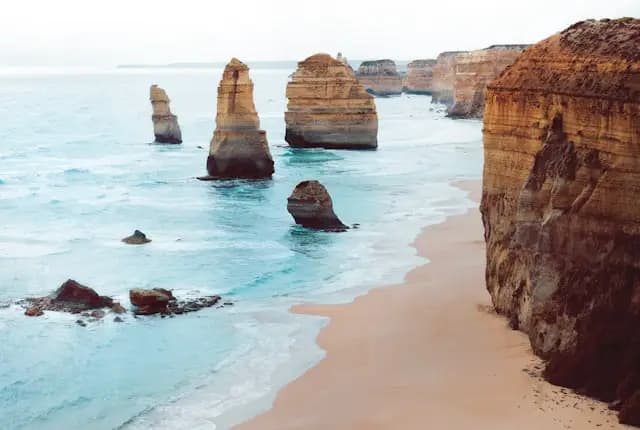

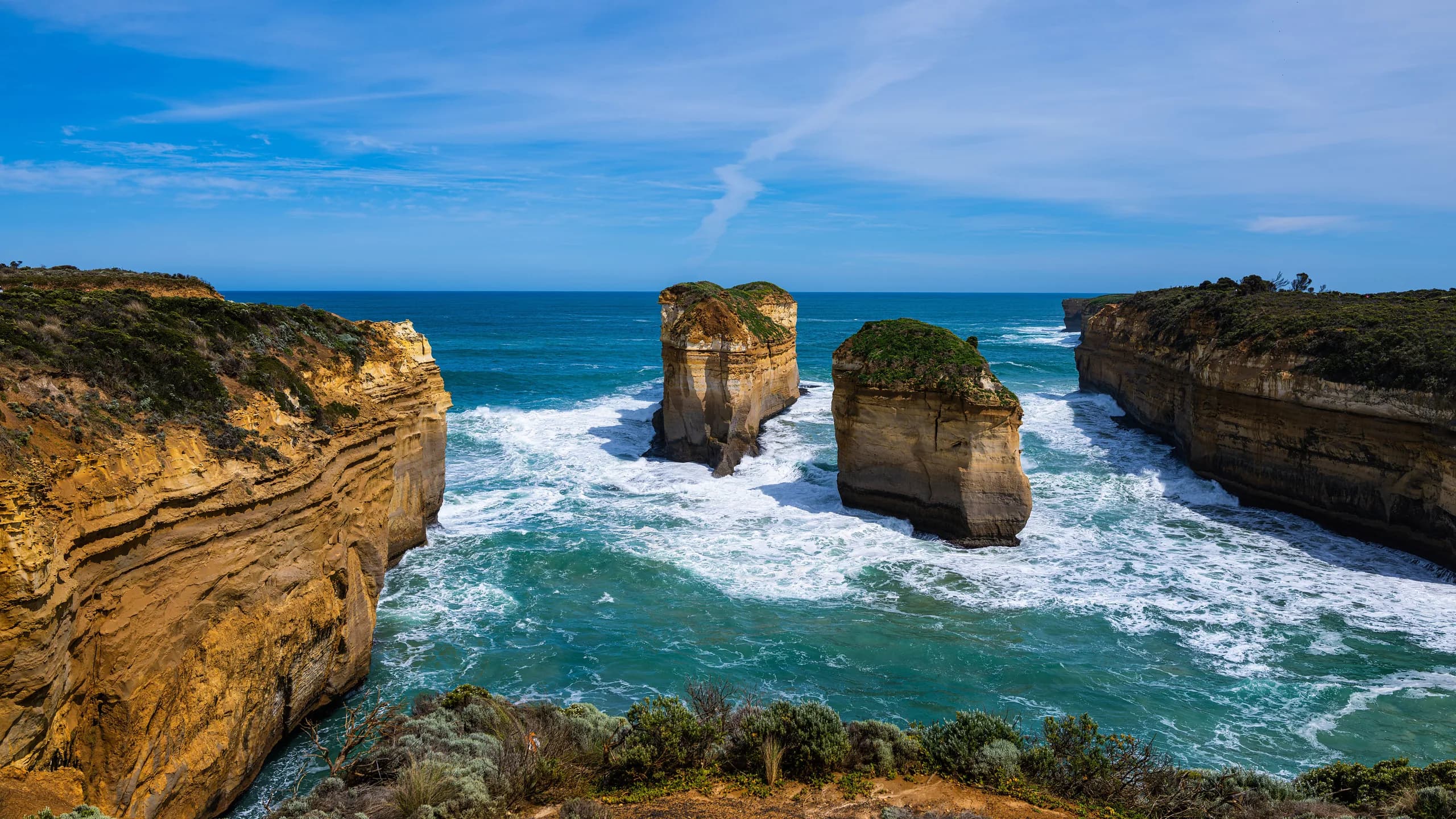
Limestone stacks and sandstone cliffs above turquoise surf on the Shipwreck Coast, near Loch Ard Gorge

Flagship day hire · Melbourne to the Apostles and back

Great Ocean Road and Twelve Apostles, in one car with your own driver.

Twelve Apostles, one car, no coach timetable. You pick the stops, the order, and how long you stay.

243 km

Of Great Ocean Road

10–12 hrs

Private hire

~600 km

Round trip

  1. Melbourne
  2. Torquay
  3. Aireys Inlet
  4. Lorne
  5. Kennett River
  6. Apollo Bay
  7. The Otways
  8. Twelve Apostles
  9. Port Campbell

The Great Ocean Road runs 243 kilometres from Torquay to Allansford, near Warrnambool. From Melbourne it is roughly 3.5 to 4.5 hours each way to the Twelve Apostles, or about 600 kilometres of driving in a single day. ME CABS runs it as a private 10 to 12 hour hire: one vehicle, one driver, your choice of stops, a fixed fare agreed before you leave.

Access checked 25 August 2026 · re-checked the morning you travel

The road itself

Built by hand, by the men who came back.

Some of this matters on the day — which way we drive it changes what you see, and who manages the gate you are standing at.

The road, in four numbers

Length
243 km
Built
1919–1932
By
~3,000 returned soldiers
Status
World's largest war memorial
  1. 01

    Length

    243 km — Torquay (official start) to Allansford, near Warrnambool.

  2. 02

    Built

    1919–1932 by around 3,000 returned World War I soldiers, largely by hand with picks and shovels.

  3. 03

    Status

    The world's largest war memorial — dedicated to the servicemen who did not come home. National Heritage listed.

  4. 04

    Three characters

    Torquay to Lorne is wide surf beaches. Lorne to Apollo Bay is cliff-hugging curves with the ocean directly below — the most scenic stretch. Apollo Bay to the Apostles runs inland through Otway rainforest, then out onto the Shipwreck Coast.

  5. 05

    Which way we drive it

    West, Torquay toward Port Campbell. Almost every lookout and pull-off sits on the ocean side, which is the left when heading west, so there is no crossing traffic. It also puts you at the Apostles in late-afternoon light.

  6. 06

    Who manages it

    From 1 July 2026 the Great Ocean Road Coast and Parks Authority (GORCAPA) manages many of the parks and sites along the road, with Parks Victoria retaining others.

The Great Ocean Road crosses the Country of the Wadawurrung and Eastern Maar peoples. We acknowledge them as the Traditional Owners of these lands and waters, and pay respect to Elders past and present.

Trip shapes that fit

Four ways to spend the day.

A day trip is roughly 600 kilometres of driving. That constraint is real, so these are the combinations that work rather than a list of everything on the coast.

The version most guests want

The 10-hour classic

Memorial Arch, Lorne for morning tea, Kennett River koalas, Apollo Bay for lunch, Maits Rest, the Twelve Apostles, Loch Ard Gorge, then home. The Apostles are reached mid-to-late afternoon in good light.

  • Memorial Arch
  • Lorne
  • Kennett River
  • Apollo Bay
  • Maits Rest
  • Twelve Apostles
  • Loch Ard Gorge

The trip that justifies a private car

The 12-hour full coast

Adds Bells Beach, Split Point Lighthouse, Teddy's Lookout or Erskine Falls, Gibson Steps, and the western lookouts at London Bridge and The Grotto — with sunset at the Apostles and a dark return.

  • Everything above
  • Bells Beach
  • Split Point
  • Teddy's Lookout or Erskine Falls
  • Gibson Steps
  • London Bridge
  • The Grotto

Best in peak season

The reverse run

Inland via the Princes Highway to the Apostles first, arriving early and ahead of the coaches, then working back east along the coast. For guests who want the Apostles without the crowds.

  • Princes Highway
  • Twelve Apostles first
  • Loch Ard Gorge
  • then east along the coast

Skips the Apostles

The rainforest day

Otway Fly, Maits Rest, Triplet and Hopetoun Falls, and Cape Otway. Suits repeat visitors, and families with young children who won't thank you for 600 kilometres.

  • Otway Fly
  • Maits Rest
  • Triplet Falls
  • Hopetoun Falls
  • Cape Otway

Said plainly

A single day covers about 600 kilometres and leaves roughly three to four hours in total at the stops. It is a real day out and most guests are glad they did it — but an overnight in Port Campbell or Apollo Bay changes the trip entirely. We would rather tell you that now than at Apollo Bay.

What you can do

Every stop worth making, west-bound.

Times are how long you spend on the ground, not how long you spend driving. Not all of them fit in one day — the four shapes above are the combinations that actually do.

01

Surf Coast

Torquay to Aireys Inlet · 7 stops

Wide surf beaches and the official start of the road, ending at the memorial arch everyone comes home with a photograph of.

Torquay

Official start of the road

On the ground · 20–30 min

Australian National Surfing Museum, the surf retail strip and the beachfront. The practical stop for coffee and fuel — fuel prices climb the further west you go. Free to walk.

Bells Beach

5 km from Torquay

On the ground · 15–20 min

Australia's surfing temple and home of the Rip Curl Pro, the longest continuously running professional surfing competition in the world, held every Easter. Headland viewing platform above the break. The beach and coastal reserve are on the Victorian Heritage Register. Dramatic even when the surf is small. Free.

Point Addis

Clifftop lookout

On the ground · 10–15 min

Wide coastal lookout and one of the recognised land-based whale-watching spots on the eastern end of the road. Free.

Anglesea Golf Course

Wildlife oddity

On the ground · 10 min

Eastern grey kangaroos graze freely on the fairways alongside golfers. A genuinely peculiar sight, and an easy wildlife win early in the day if Kennett River is running late.

Split Point Lighthouse, Aireys Inlet

Built 1891

On the ground · 15–45 min

Known as the White Queen, and recognisable to many guests as the lighthouse from Round the Twist. Grounds and clifftop walks are free; tower tours are ticketed and give 360-degree views from the lightroom. Adjacent Eagle Rock Marine Sanctuary and Lighthouse Tea Rooms. Dolphins offshore, and whales in season.

Fairhaven Beach

Swim stop

On the ground · 15–30 min

Long open surf beach, patrolled in summer. The practical swim stop on the eastern half.

Memorial Arch at Eastern View

The photo everyone wants

On the ground · 10–15 min

The timber arch over the road between Aireys Inlet and Lorne, first erected in 1939 and rebuilt since. It commemorates the returned soldiers who built the road; the original was dedicated to W.B. McCormack, honorary engineer of the Great Ocean Road Trust. Interpretive plaques, a memorial sculpture, a small beach and a safe pull-in. The most photographed spot on the road. Free.

02

Lorne to Apollo Bay

The scenic stretch · 7 stops

The cliff-hugging half, with the water directly below the road — and the most reliable wild koalas in Victoria at Kennett River.

Lorne

Main service town, east

On the ground · 45–75 min

The usual morning tea or lunch stop. Loutit Bay swimming beach, Mountjoy Parade cafés and boutiques, and Lorne Pier for a walk. The Great Ocean Road Story exhibit at the Lorne Visitor Information Centre covers how and why the road was built. Public toilets at the main beach car park and the Loutit Bay foreshore.

Erskine Falls

10 km inland from Lorne

On the ground · 45–75 min including the detour

A 30-metre fall dropping into a fern gorge. The upper viewpoint is about a minute from the car park; the lower viewpoint is a steep descent of roughly 250 steps and has been subject to closure for step condition, so we confirm its status on the day. Alternative: the 7.5 km walking route from Lorne along the Erskine River. Best early, before the car park fills.

Teddy's Lookout

Short detour above Lorne

On the ground · 15–20 min

A short walk from the car park to a platform above the point where the St George River meets the ocean, with the road curving below. The best single view of the road as a road.

Sheoak Falls & Cumberland River

Quiet alternatives

On the ground · 20–30 min

Roadside falls and a river valley just south of Lorne. Useful when Erskine Falls is crowded or the day is running tight.

Wye River & Kennett River coastal stretch

Most dramatic driving

On the ground · Drive-through with pull-offs

The road clings to the cliff edge with the water directly below, passing small villages and beaches. There are numerous pull-outs — this is where an unhurried driver earns their keep.

Kennett River koala walk

Highest-value wildlife stop

Grey River Road

On the ground · 20–40 min

Park at the general store and walk up Grey River Road, looking up into the blue gums. This is one of the most reliable wild koala locations in Victoria and it is completely free. Sightings of ten to twenty koalas in half an hour are commonly reported, with king parrots, rosellas and kookaburras through the same stretch. Do not touch or feed the wildlife — feeding is harmful and, for koalas, illegal. Walking a little further past the tour coaches usually clears the crowd.

Apollo Bay

Halfway town

On the ground · 45–60 min

The standard lunch stop. Harbour, main-street cafés and the Fishermen's Co-op for fish and chips or crayfish. Marriners Lookout is a short drive plus a walk for a panorama over the bay, and also a paragliding launch. Old Cable Station Museum. WinterWild festival in the colder months.

03

The Otways

Rainforest, lighthouse, waterfalls · 6 stops

The road turns inland into cool-temperate rainforest, waterfalls and the oldest surviving lighthouse on mainland Australia.

Maits Rest Rainforest Walk

Great Otway National Park

On the ground · 30 min

An 800-metre self-guided boardwalk loop through cool-temperate rainforest — myrtle beech, blackwood and tree ferns, some trees several hundred years old. Flat, sheltered, no ticket. The single best low-effort rainforest stop on the route, and an easy add for guests who can't manage stairs.

Cape Otway Lightstation

Tower closed

Built 1848 · ~12 km off the highway

On the ground · 60–90 min including the access road

The oldest surviving lighthouse on mainland Australia, standing 90 metres above Bass Strait — the "Beacon of Hope", and for many nineteenth-century migrants the first land sighted after months at sea. Heritage precinct, telegraph station, Aboriginal cultural interpretation and the Lightkeeper's Cafe. Managed by GORCAPA and run not-for-profit. Koalas are often in the trees along the access road. The lighthouse tower interior and tower climbs are closed for heritage restoration; the wider precinct remains open at discounted entry. Open daily 9am–5pm, last entry 4.30pm.

Otway Fly Treetop Adventures

Ferguson, inland detour

On the ground · 60–90 min plus a significant detour

A 600-metre steel walkway 25 to 30 metres up through the canopy, with a 47-metre spiral tower and a cantilevered springboard lookout. A guided zipline tour runs about 2.5 hours, up to 30 metres above the forest. Prehistoric Path with dinosaur sculptures for kids, and stroller-friendly. Open daily 9am–5pm except Christmas Day, last entry 3.30pm; ticketed. Realistically this is an alternative to the Apostles on a one-day trip, not an addition.

Otway waterfalls

Triplet, Hopetoun, Beauchamp, Phantom

On the ground · 30–60 min each

Triplet Falls runs three streams through myrtle beech and tree ferns. Hopetoun and Beauchamp sit close together and pair with the Redwoods plantation at Aire Valley. Phantom Falls is a 15-metre drop into the St George River. All are at their strongest after winter rain.

Melba Gully

Glow worms, after dark

On the ground · 30–45 min, night only

Glow worms in the fern gullies, with free access. Only viable on an overnight or a very late return — treat it as a two-day option rather than a day-trip stop.

Great Ocean Walk

Context, not a stop

On the ground · 104 km end to end

The coastal walking track from Apollo Bay to the Twelve Apostles. If you want to walk a section, we can drop you at one trailhead and collect you at another — which is something a coach cannot do.

04

Shipwreck Coast

The Twelve Apostles precinct · 4 stops

Out of the forest and onto the limestone — the Apostles, the steps down to the beach, and the gorge named for the clipper wrecked below it.

Gibson Steps

Reopened Feb 2026

1 km east of the Apostles

On the ground · 30–60 min

86 steps down the cliff face to Gibson Beach, where two 70-metre stacks — Gog and Magog, not counted among the Apostles — stand at ground level. The steps were carved by settler Hugh Gibson, working from access traditionally used by the Kirrae Whurrong people of the Eastern Maar nation. Beach access reopened on 19 February 2026 after a June 2025 rockfall closure. Access remains tide- and swell-dependent and the gate is closed in rough conditions. The small car park fills fast; the 1.1 km path from the Twelve Apostles visitor facility (2.2 km return) is the reliable approach, though it is narrow gravel and not suited to prams or wheelchairs. Not suitable for limited mobility.

Twelve Apostles

The reason people come

Port Campbell National Park

On the ground · 45–75 min

Limestone stacks up to about 45 metres on Parks Victoria's measure, standing off a cliff line the Southern Ocean is still eating. There were never twelve — and there are seven today, after collapses in 2005 and 2009. They were charted as the Sow and Piglets and renamed in a 1920s tourism campaign. Free entry, free parking, toilets and a kiosk on site, and a sealed wheelchair-accessible path from the visitor facility to the viewing platforms. Best light at dawn and dusk; the middle of the day is both flat and crowded. Helicopter flights over the stacks and the Shipwreck Coast depart from the heliport behind the visitor centre. The $126 million Twelve Apostles Precinct Redevelopment is under construction, so expect staging changes to parking and paths.

Loch Ard Gorge

Beach steps reopen Oct 2026

5 min west of the Apostles

On the ground · 45–90 min

The most underrated stop on the road. Named for the clipper Loch Ard, wrecked on Mutton Bird Island on 1 June 1878 at the end of a three-month voyage from England. Of 54 aboard, two survived: apprentice Tom Pearce and passenger Eva Carmichael, both 19. Around 7 km of linked trails run from one car park. Beach access steps into the gorge have been shut since May 2023 for cliff remediation; GORCAPA has announced they return in October 2026, and we confirm whether they are actually open for your date rather than assume it. The lookouts and every trail above the gorge are open throughout. Mutton Bird Island holds a large short-tailed shearwater colony that returns to burrows at dusk in the warmer months.

  • Geology Walk — 900 m return, sealed and crushed rock, takes in The Razorback and Island Arch lookouts.
  • Loch Ard Wreck Lookout — 600 m return to the headland.
  • Wreck of the Loch Ard — 1.4 km, past the cemetery where victims are buried, continuing toward Mutton Bird Island lookout.
  • Living on the Edge — 3.2 km with inclines.
  • Thunder Cave — 1.1 km return, sealed.
  • Poombeeyt Koontapool — 500 m return to the blowhole lookout, an $8 million platform completed in 2025. The name means "Breath of the Whale" in Keerray Woorroong, and the design is drawn from the story of Koontapool, the southern right whale.

Port Campbell

Town

On the ground · 30–45 min

Sheltered bay, jetty, a visitor information centre with shipwreck material, and a pedestrian bridge over Port Campbell Creek. The practical late-lunch or coffee stop before the western lookouts, and the natural turnaround point on a day trip.

05

Western lookouts

Beyond Port Campbell · 4 stops

Past Port Campbell the crowds thin and the same geology keeps going — an arch, a grotto, scattered stacks and a whale nursery.

London Bridge (London Arch)

7.5 km west of Port Campbell

On the ground · 20–30 min

Once a double-arched formation connected to the mainland; the shoreward span collapsed on 15 January 1990, stranding two tourists on the remaining arch who were lifted off by helicopter. Four sealed lookouts on a short paved circuit. Little Penguins come ashore on the beach below at dusk, and in winter southern right and humpback whales pass offshore.

The Grotto

2 km further west

On the ground · 20–30 min

Part blowhole, part archway, part cave — a hollow in the cliff about halfway down, reached by a decked staircase to a viewing deck over still rock pools framing open ocean. The most intimate formation on the coast, and the one guests photograph hardest.

Bay of Islands & Bay of Martyrs

Past Peterborough, ~12 km west

On the ground · 20–30 min

Clifftop lookouts over scattered offshore stacks and jagged limestone crags. Far quieter than the Apostles for the same geology — the stop that makes a guest feel they were shown something, rather than processed through it.

Warrnambool — Logans Beach whale nursery

Extended day or overnight

On the ground · 45–60 min, seasonal

Southern right whales return between June and September to calve, often within 100 metres of shore. A purpose-built platform in the dunes is free, open at all times and ramped for accessibility. Sightings are not guaranteed on any single visit — the Warrnambool Visitor Information Centre posts daily updates. Also in town: Flagstaff Hill Maritime Village. This sits beyond a comfortable day-trip radius from Melbourne, so we run it as a two-day itinerary.

How the Apostles got there

University of Melbourne research published in April 2026 revised the age and origin of the Apostles. The limestone formed on the seafloor between roughly 11.6 and 8.6 million years ago; tectonic movement then lifted and tilted it from around 8.6 million years ago; and the stacks themselves were carved by coastal erosion only in the last few thousand years, after post-ice-age seas rose. The study mapped more than 40 kilometres of near-continuous sea cliffs across the Port Campbell Embayment, with stacks standing 40 to 70 metres.

University of Melbourne · Australian Journal of Earth Sciences · April 2026

Access and closures

What is actually open on the day you go.

This coast closes things at short notice — rockfalls, swell, cliff remediation, heritage works. Four hours is a long way to drive to a locked gate, so here is where every contested stop stands today.

Gibson Steps

Beach access reopened 19 Feb 2026

Open, but tide- and swell-dependent; the gate closes in rough conditions.

Loch Ard Gorge beach steps

Shut since May 2023 · reopening announced for October 2026

Lookouts and trails are open throughout. An announced date is not an open gate, so we confirm the steps before your day rather than promising beach access on the strength of it.

The Arch

Closed since Feb 2022, no reopening planned

Not on any itinerary we build.

Erskine Falls lower viewpoint

Subject to closure for step condition

The upper viewpoint is always available. We confirm the lower one on the day.

Cape Otway lighthouse tower

Tower interior and climbs closed for heritage works

The precinct is open at reduced entry. We do not sell the tower climb.

Twelve Apostles precinct

$126m redevelopment under construction

Parking and path staging may change; we check before departure.

We check the GORCAPA and Parks Victoria changed-conditions pages the morning you travel, so the itinerary you are given is the itinerary that exists.

When to go

The coast is a different trip in every season.

There is no bad month, only different trips. The line at the foot of each panel is what that month is actually for.

Dec–Feb

Warmest swimming and the longest daylight. Also the heaviest traffic and fullest car parks, especially late January.

Beach day and long light — leave Melbourne early.

Mar–May

Mild days, clean swell, fewer cars and deep light. Otway colour late in the season.

The best all-round window. Prime photography.

Jun–Aug

Southern right whales calving at Logans Beach, and whales visible from Cape Otway, Point Addis and the cliffs between Port Campbell and Peterborough. Huge swell at the Apostles and Loch Ard Gorge. Waterfalls at full flow. Short days.

Storm coast and whale season — a genuinely different trip.

Sep–Nov

Wildflowers in the heath, waterfalls still strong, the end of whale season and young koalas.

Green, quiet, variable weather.

What you can actually see, and where

Koalas
Kennett River, up Grey River Road, is the reliable one. Cape Otway's access road is the backup.
Kangaroos
Anglesea Golf Course fairways, and through the Otway clearings.
Little Penguins
Ashore at dusk on the beach below London Bridge lookout.
Short-tailed shearwaters
Mutton Bird Island at dusk, in the warmer months.
Southern right whales
June to September, at the Logans Beach nursery and clifftop lookouts along the coast.
Parrots, rosellas, kookaburras, echidnas
Through Kennett River and the Otways.

Never touch or feed wildlife. Feeding koalas is illegal and harmful. Dogs are not permitted anywhere in Port Campbell National Park.

Why book it this way

One car, held for you, for the whole day.

The three alternatives are a hire car, a coach seat and a rideshare app. Here is honestly how each of them goes on this particular road.

Why trust us with a full day

  • Licensed commercial passenger vehicle operator with a fixed-fare promise — the fare you see is the fare you pay, agreed before departure, with no meter running while you stand at a lookout.
  • The driver checks GORCAPA and Parks Victoria closures the morning you travel.
  • A Melbourne-based operator running regional Victoria work daily, not a metro taxi taking a day off.
  • Cabcharge accepted, and MPTP recognised.

Why not drive it yourself

  • 600 kilometres, much of it winding cliff road, in one day. The person driving does not see the coast.
  • Car parks at Kennett River, Gibson Steps and the Apostles fill. A driver drops you at the entrance and waits.
  • No hire car deposit, no fuel, no tolls, no parking, and no fatigue on the dark run home.

Why not a coach tour

  • A coach runs a fixed timetable with up to fifty people and roughly fifteen minutes a stop. If the koalas are quiet at Kennett River, the coach still leaves.
  • You pick the stops, the order, and how long you stay. Skip The Grotto and stay longer at Loch Ard Gorge — that is your call, on the day.
  • Door-to-door from your hotel or address, not a CBD assembly point at 6.45am.
  • Sunset at the Apostles is possible, because your car waits for you.

Why not rideshare

  • Rideshare does not do regional day hire. There is no return trip from Port Campbell at 7pm, and surge pricing is not a fixed fare.
  • No accountable driver, no vehicle held for the day, and no accessible or maxi option on demand.

Why dates go early

  • Full-day regional hires take a vehicle and driver out of the metro fleet, so weekend and school-holiday dates go early.
  • Whale season from June to September, and summer sunset trips, are the tightest windows.
  • Group and mobility vehicles are limited in number and must be reserved, not requested on the day.

Vehicle and group

Pick the car for the number of you.

Allocation for a full-day regional run is confirmed when we quote the day, so the car that turns up is one suited to 600 kilometres.

Flex

1–3 guests

Standard sedan. Fine for the classic 10-hour run.

Our pick for a full day

Plus

1–4 guests

Premium sedan or SUV. Our default recommendation for a full day — comfort matters over 600 kilometres.

Group

5–7 guests plus luggage

People mover. The right call for families and small groups, and the only sensible option if you want gear or picnic supplies.

Mobility

Wheelchair passengers

Must be booked ahead. We pair it with the accessible stops below.

Stops that work for wheelchairs and limited mobility

  • Twelve Apostles — sealed, wheelchair-accessible path to the viewing platforms, with accessible parking and facilities.
  • Loch Ard Gorge — accessible parking; the Geology Walk and Loch Ard lookout trails are level crushed rock and bitumen.
  • Maits Rest — flat boardwalk loop.
  • Logans Beach platform — ramped, free and open at all times.
  • Memorial Arch, Teddy's Lookout and London Bridge — short sealed approaches from the car park.

The honest exceptions

Not suitable: Gibson Steps beach (86 steep steps, narrow), the Erskine Falls lower viewpoint, and The Grotto lower deck.

Before you go

The practical part.

The eight things guests ring up about the night before.

Pickup

Door-to-door from any Melbourne hotel or address. A full day typically departs between 7.00 and 8.00am.

Fuel and tolls

Included in the fixed fare. No surprises at the end.

Food

Meals are not included. The driver builds in stops at Lorne, Apollo Bay or Port Campbell, and you are welcome to bring your own.

Weather

The coast takes the full force of the Southern Ocean and conditions change fast. Bring layers and a windproof jacket in every season.

What to bring

Comfortable shoes, water, sunscreen and a hat even on overcast days. Binoculars in whale season, and a zoom lens for koalas high in the gums.

Toilets

Torquay, Lorne main beach, Apollo Bay, the Twelve Apostles visitor facility, and Port Campbell.

Mobile coverage

Patchy through the Otways and around Cape Otway.

Safety

Stay behind barriers and on platforms. Cliff failures happen without notice along this coast, and large unexpected waves reach well up the beaches.

Questions

What guests ask before they book.

How long is the Great Ocean Road?

243 kilometres, from Torquay to Allansford near Warrnambool. A Melbourne day trip covering the Twelve Apostles and returning is around 600 kilometres in total.

How long does it take to get to the Twelve Apostles from Melbourne?

Roughly 3.5 to 4.5 hours each way along the coast, or about 3 hours inland via the Princes Highway. Most guests go out one way and back the other.

How many Twelve Apostles are left?

There were never twelve. Seven stacks remain today, after collapses in 2005 and 2009 — that is the figure Parks Victoria and the 2026 University of Melbourne survey both give. They were originally charted as the Sow and Piglets and renamed in a 1920s tourism campaign.

Can I walk on the beach at the Twelve Apostles?

Yes, via Gibson Steps — 86 steps down to Gibson Beach, about a kilometre from the Apostles. Beach access reopened in February 2026 after a rockfall closure. It depends on tide and swell, and the gate is closed in rough conditions.

Where can I see koalas on the Great Ocean Road?

Kennett River. Park at the general store and walk up Grey River Road, looking into the blue gums. It is free, and one of the most reliable wild koala spots in Victoria. Cape Otway's access road is the backup.

Can this be done in one day?

Yes, and most of our guests do. It is a full day of about 10 to 12 hours with roughly three to four hours at the stops. If you want the Otway Fly, the western lookouts and Warrnambool as well, plan two days.

What is the best time of year to go?

Autumn from March to May, and spring from September to November, give the mildest weather and the fewest cars. Winter brings southern right whales at Warrnambool and huge swell at the Apostles. Summer is warmest but busiest.

Is it wheelchair accessible?

The Twelve Apostles viewing platforms, the main Loch Ard Gorge lookout trails, Maits Rest and the Logans Beach platform are all accessible. Gibson Steps beach is not. Book a mobility vehicle in advance and we will build the day around accessible stops.

What does it cost?

The day is quoted as a fixed fare before you book, based on the vehicle you need and the shape of the day. Tell us your date, how many guests, and the stops that matter, and we will put a figure in writing. Fuel and tolls are inside it.

Can we choose our own stops?

Yes. Tell us what matters — koalas, waterfalls, the shipwreck history, sunset at the Apostles — and the driver builds the day around it, checking closures the morning you travel.

Plan the day

Tell us the stops that matter. We will quote the day before you book it.

Fuel and tolls are inside the fare, the car is yours for the hours you book, and we check the closures the morning you travel.

Access statuses on this page are current as at 25 August 2026 and are re-verified before travel. Sources include Parks Victoria, the Great Ocean Road Coast and Parks Authority, Visit Great Ocean Road, Visit Victoria, Cape Otway Lightstation, Otway Fly, Warrnambool City Council, the Victorian Department of Jobs, Skills, Industry and Regions, and University of Melbourne geology research published in the Australian Journal of Earth Sciences in April 2026.